
Yoakum County Court Records After Arrest
After a Yoakum County jail arrest, the record path splits. The Yoakum County Law Enforcement Center, operated by the sheriff's office under Sheriff Robert Whitfield, handles booking, custody, release, bond status, and transfer questions. The court record begins when a criminal case is opened or when a filed charge, warrant return, setting, plea, motion, judgment, or sentence becomes part of the clerk's file. That difference matters because an arrest is not the same thing as the charge that is later filed in court.
The local prosecutor is the Yoakum County Criminal District Attorney. The official page names Paul E. Mansur as Criminal District Attorney and gives the office phone as 806-456-7491 Ext. 6. The prosecutor reviews the arrest facts and decides whether to file, change, reduce, dismiss, or pursue charges. For jail custody and booking information, use Yoakum County jail inmate records. For booking photos, use Yoakum County jail mugshots. Court records after arrest focus on the case file.
The official Criminal District Attorney page is a subject-fit source for the charging path after a Yoakum County arrest: Yoakum County Criminal District Attorney.
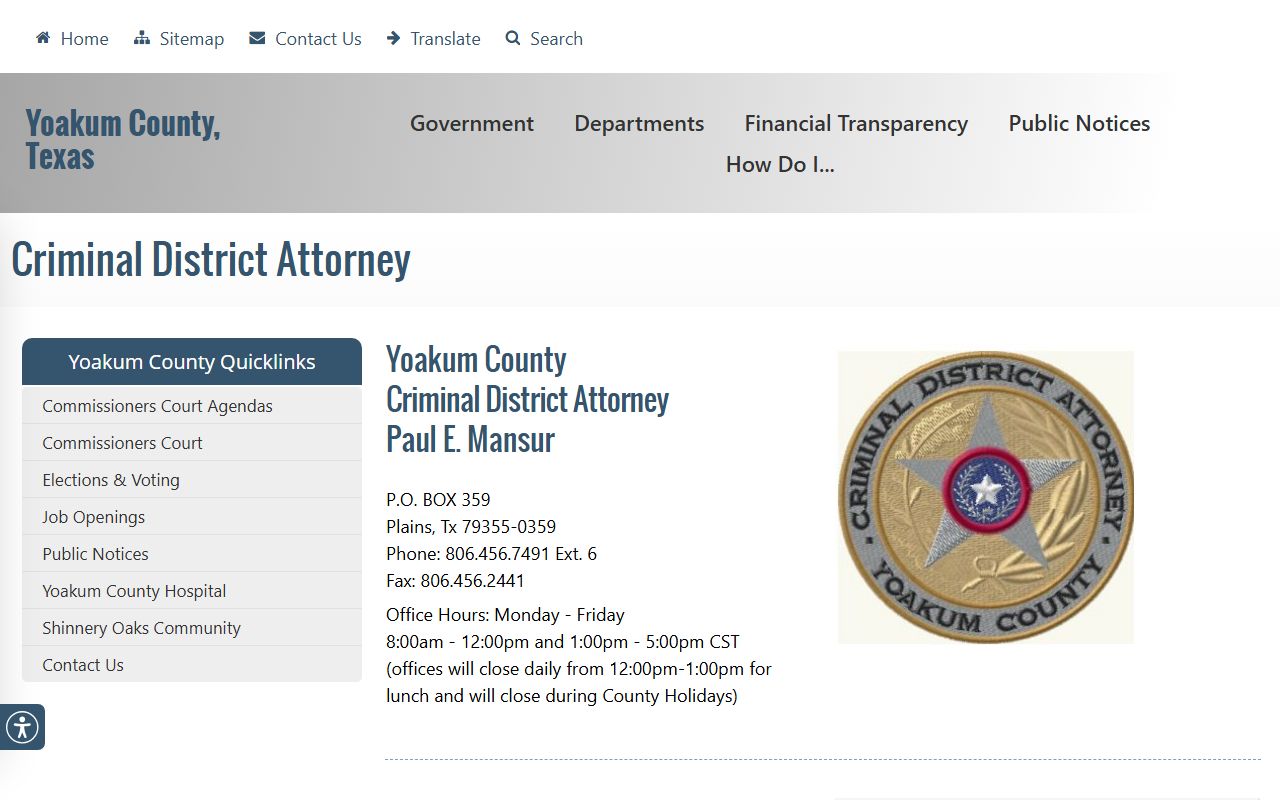
The prosecutor page helps place filed charges in context, but it is not the jail phone line and should not be used to confirm current custody.
Find Yoakum County Arrest Court Records
For district criminal matters, the key local record office is the Yoakum County District Clerk. The district clerk page names Honorable Sandra Roblez as district clerk and states that the office is the registrar, recorder, and custodian for documents that are part of criminal and civil actions. The courthouse mailing address is P.O. Box 899, Plains, Texas 79355, and the phone is 806-456-7491 ext. 297.
The 121st District Court page gives the district court context. It names Judge John A. Didway, lists the Yoakum County Courthouse physical address as 609 Cowboy Way in Plains, and gives court staff mailing and contact details in Brownfield. The Yoakum County homepage gives the courthouse location and county hours, and the Yoakum County Sheriff page remains the local custody source. That regional court arrangement is a useful warning: do not mail court papers to the jail just because the arrest began there.
- Confirm the person was booked through the Yoakum County Law Enforcement Center if the question starts with current custody or bond.
- Contact the Yoakum County District Clerk for district criminal case records, case numbers, filed documents, and clerk file access.
- Use the 121st District Court page for schedule context, court staff contacts, and official court forms.
- Ask the Criminal District Attorney's office about prosecutor-filed charges only when the inquiry fits that office's role, such as victim services or e-file notice information.
- For justice-court matters, use the posted Justice of the Peace contacts for Precinct 1 in Plains or Precinct 2 in Denver City.
Texas also has re:SearchTX, a statewide court-record access portal. It should be treated as a possible search channel, not as a promise that every Yoakum County criminal filing is free, complete, or available online. Registration, court participation, document access, fees, and restricted records can affect what a user sees.
Yoakum County Court Search Caveats
A statewide portal can help when a court participates and the record is open for the level of access being used. Clerk contact is still important in Yoakum County because the research did not locate a county-published criminal case search that guarantees full public document access for every arrest-based case.
| Search Item | How It Helps | Yoakum County Caveat |
|---|---|---|
| Name search | Can locate parties when a case is indexed by defendant name. | Name spelling, aliases, and common names can produce missed or mixed results. |
| Case number | Best route when the number appears on bond papers, clerk notices, or court forms. | Call the district clerk if the jail booking did not provide a court case number. |
| Location or court filter | Narrows a statewide search to the right court. | Availability depends on court participation and access settings. |
| Document access | May show filings, orders, or docket entries. | Some documents require login, fees, clerk contact, or may be restricted. |
The re:SearchTX court portal is the matching statewide source shown in the research manifest.
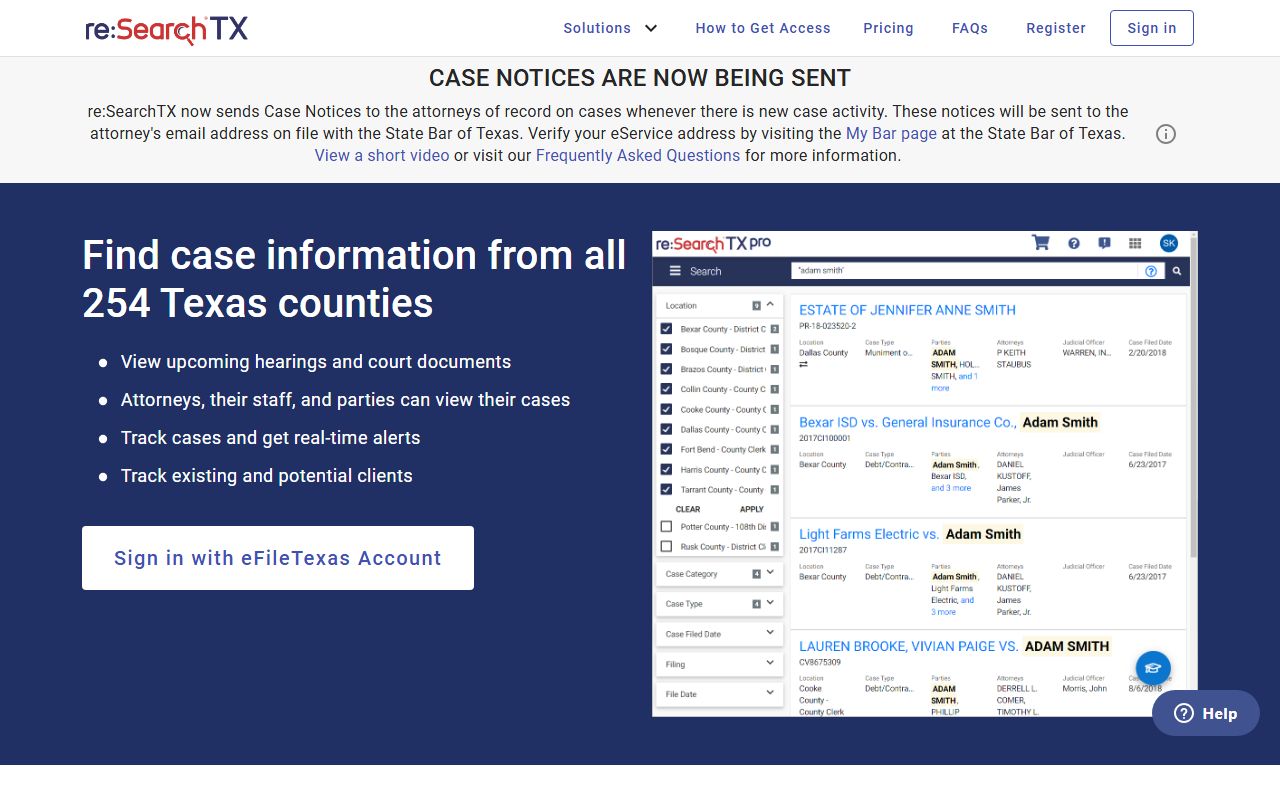
Use a portal result as a lead, then verify filed charges and document availability with the clerk that holds the official court record.
Charging Documents After Yoakum Arrest
A booking charge often comes from the first arrest report or warrant information. The charging document is different. It is the document that puts a formal accusation before a court. In Yoakum County, the Criminal District Attorney reviews arrest allegations and files the appropriate charging paper based on the case type and stage. The charge can be added, amended, reduced, or dismissed after that first filing.
| Document | Common Use | What to Check |
|---|---|---|
| Complaint | Initial sworn accusation or lower-level criminal filing. | Offense name, date, probable-cause basis, and court listed. |
| Information | Prosecutor-filed charge often used where indictment is not required or has been waived. | Filed charge level, prosecutor signature, and any amended count. |
| Indictment | Grand-jury charging document for felony prosecution. | Count numbers, offense level, enhancement language, and arraignment setting. |
Do not treat any one line on a jail intake record as the full court case. A person can be booked for one suspected offense, then face a different formal charge once the prosecutor reviews reports, lab results, witness information, or prior warrant history.
Yoakum County Charge Status Records
Charge status is the current posture of a filed accusation. It is one of the most important parts of court records after a jail arrest because it shows whether the case is merely pending, has changed form, has ended, or has moved toward sentencing. Status language may appear on docket sheets, clerk records, court orders, or prosecutor filings.
| Status | Meaning | Record Check |
|---|---|---|
| Pending | The charge remains open and has not reached final disposition. | Look for the next setting, bond order, or pending motion. |
| Amended or reduced | The filed charge has changed from the original count. | Compare the first filing to later information, indictment, plea paper, or order. |
| Dismissed | The court record reflects that the charge was ended without conviction on that count. | Read the dismissal order or docket entry, not just an informal note. |
| Convicted | A plea, verdict, or judgment resulted in guilt on the charge. | Check the judgment, sentence, fine, confinement term, or probation terms. |
| Warrant or capias active | A court order may require arrest or return to court. | Verify with the issuing court or sheriff before relying on stale information. |
Note: A charge status is time sensitive, so verify it with the clerk or court before taking action.
Bond Records After Jail Arrest
Bond sits between the jail and court tracks. The jail can usually confirm whether a person is in custody and whether a public bond status can be released. The court or magistrate controls the legal terms. Texas Code of Criminal Procedure Chapter 17 is the main bail chapter, while Chapter 15 covers arrest-warrant and magistrate-warning procedures.
Call the Law Enforcement Center first for current custody and bond status. Ask whether the person is bondable, whether bond has been set, what court or magistrate set it, and whether another hold prevents release. Yoakum County did not publish a jail bond payment-method list, so payment location, accepted forms, and after-hours procedures should be confirmed before a family member travels.
| Bond Type | Practical Meaning |
|---|---|
| Cash bond | Money is deposited directly with the proper court or authority to secure appearance. |
| Surety bond | A licensed bail bond company posts the bond, usually for a fee. |
| Personal recognizance bond | The person is released on a promise to appear, sometimes with conditions. |
| No-bond hold | Release is blocked until the court or holding agency changes the status. |
Yoakum County Warrants and Arrest Records
No official Yoakum County active-warrant search, warrant list, or most-wanted page was located in the reviewed county sources. That does not mean a warrant is absent. It means the safe route is to use the sheriff, clerk, court, or justice court that may hold the record. The sheriff's office provides law enforcement, civil, detention, and court-security services, while warrant records may also originate in district court, a justice court, another Texas county, or another state or federal agency.
For district case warrants, contact the district clerk at 806-456-7491 ext. 297. For 121st District Court schedule or staff information, use the court page. Justice of the Peace Precinct 1 is listed at the Yoakum County Courthouse in Plains, and Precinct 2 is listed at 201-A North Main in Denver City. A person can be in the Yoakum County jail on a bench warrant, arrest warrant, capias, fugitive hold, parole matter, or out-of-county hold even when no new Yoakum County criminal case has yet been filed.
Charges Versus Convictions
Many court records after an arrest show charges that have not led to a conviction. A charge is an accusation. A conviction is a final outcome based on a guilty plea, no-contest plea accepted by the court, jury verdict, bench trial finding, or other judgment of guilt. Treating the two as the same can lead to serious errors.
| Point | Charge | Conviction |
|---|---|---|
| Stage | Accusation after arrest or filing. | Final guilt finding or accepted plea. |
| Proof level | Often starts from probable cause or prosecutor review. | Requires the legal standard for guilt in court. |
| Record source | Complaint, information, indictment, docket, or warrant record. | Judgment, sentence, plea papers, or final disposition entry. |
| Risk of misuse | Can be amended, reduced, or dismissed. | Still requires accurate reading of the sentence and appeal status. |
Note: A booking photo, if one exists, proves booking only. It does not prove guilt or final case outcome.
Sealed and Expunged Arrest Records
Texas provides record-limiting remedies, but they are not the same. Expunction under Texas Code of Criminal Procedure Chapter 55A can remove eligible arrest records from public use in qualifying situations. Nondisclosure limits public disclosure of certain criminal history records without treating the arrest as though it never existed. The Yoakum County District Clerk page links expunction help, and the County Clerk page includes a nondisclosure link, but eligibility depends on the facts and the final case result.
| Issue | Nondisclosure or Sealing | Expunction |
|---|---|---|
| Public view | Limits disclosure to the public when granted. | Removes or destroys eligible records as ordered. |
| Record effect | Some agencies may still have access. | The record is treated much more strictly after the order. |
| Typical trigger | Eligible disposition or completed program. | Eligible dismissal, acquittal, no filing, or other statutory ground. |
| Where to verify | Clerk, court order, and Texas law. | Clerk, court order, and Chapter 55A. |
Public Access and Record Limits
Texas Government Code Chapter 552 is the Texas Public Information Act. The Texas Attorney General explains that people may inspect or copy government records unless an exception applies. For Yoakum County court records after a jail arrest, that means the public may be able to request clerk records, booking records, jail logs, or related documents, but law-enforcement exceptions, juvenile protections, sealed files, expunction orders, medical privacy, victim information, and active-case limits can still apply.
Use the right office for the record. The sheriff's office is the local jail and law-enforcement contact. The district clerk is the official file custodian for district criminal actions. The 121st District Court handles court proceedings and schedule context. The Criminal District Attorney prosecutes criminal cases and lists victim assistance staff. A single arrest can touch all of those offices, but each office holds a different part of the public record.
Important: Public court and jail lookup information is not a consumer report and may not be used for FCRA-covered screening.